


Are you considering moving to Bend, Oregon? Nicole and I are doing that now, from Frederick, Maryland. There are a lot of reasons to do so as Bend is a desirable place to live, work, or retire.
So you are probably wondering: what is the real cost of living in Bend, Oregon?
The short answer: Bend’s amazing lifestyle comes with a cost. The cost of living here is above the national average. You will feel it if and when you move here, especially in one major area: housing.

Outside of housing, Bend looks a lot more ordinary. Utilities and groceries run close to average. Oregon has no sales tax, and much of what makes Bend great (trails, rivers, mountains) is free.
And if you are coming from Seattle, California, or a big East Coast metro, the affordability math can look quite favorable.
We break it down for you in this article.
The Real Cost of Living in Bend, Oregon

Is Bend, OR Expensive to Live In?
If you are considering moving to Bend or surrounding towns like Redmond or Sisters, you are probably asking the same questions Nicole and I did:
“Can we afford to live there?”
“How will our cost of living change from where we live now?”
“What will cost more in Bend, and what will cost less?”

The answers depend on your situation:
- Will you rent or buy?
- Will you work locally, remotely, or not at all?
- Which side of town do you want to live on?
- How much of your free time will be spent outdoors?
This guide will help you answer these questions.
Why It Costs What It Does to Live in Bend, OR
This article won’t be heavy on statistics (you can get plenty from other sources). But…
First, you should understand what drives the cost of living in Bend. It starts with understanding why so many people want to live here, why Bend is growing, and what shapes things like the high demand for housing:
- Incredible Year-Round Outdoor Recreation (Mt. Bachelor, the Deschutes River, Three Sisters Wilderness, Phil’s Trails)
- A Lively Downtown, Breweries, and Restaurant Scene
- Remote Workers and Retirees Moving In
- Oregon’s Urban Growth Boundary, Which Limits Sprawl
- Second Homes and Short-Term Rentals
- Central Oregon’s Regional Hub for Healthcare and Shopping
- Population Growth and New Neighborhoods

Frankly, many people are moving to Bend, just like Nicole and me.
As we shared in Retiring in Bend, Oregon: Why We Left Maryland for the High Desert, Bend’s appeal is the lifestyle. Trails, golf, skiing, and rivers are minutes from home in a town that still feels small.
That demand is exactly what you pay for.
Plus, Bend is a great place if you work remotely and don’t need to commute. In fact, Bend has one of the highest percentages of remote workers in the country, with approximately 28% of its workforce working remotely.
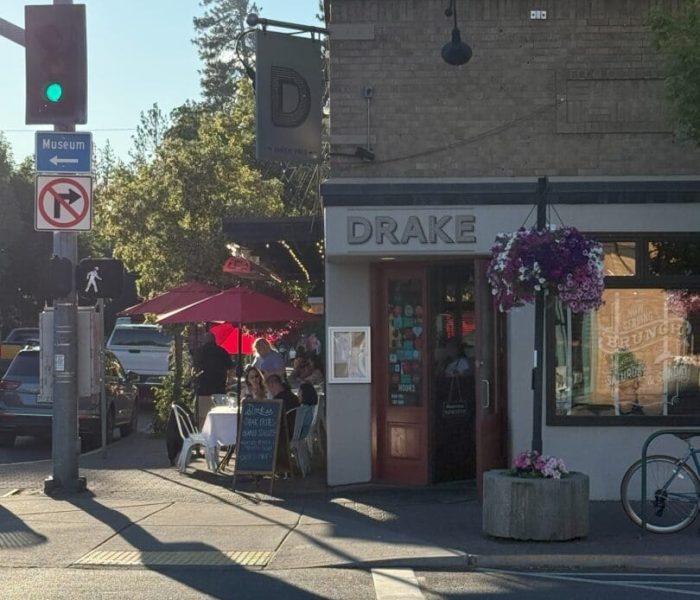
Bend also has housing constraints related to urban boundaries. When you combine a highly desirable place to live with these housing constraints, it can create affordability issues.
Breaking Down The Costs to Live in Bend, OR
If you simply compare the cost of living in Bend to the national average, you’ll find it’s clearly higher.
Sources rank the cost of living in Bend anywhere from 4% to 34% higher than the national average, with an average of about 19%.

However, many people reading this article are considering a move to Bend from higher-cost places like Seattle, the Bay Area, Southern California, Denver, or the big East Coast metros. That requires a more specific analysis.

Also, because the cost of living is an aggregate of many affordability factors, each of which varies by location, it’s best to break it down.
Below, we discuss the main cost-of-living categories and what they look like in Bend.
Housing Costs in Bend, OR
The first and biggest factor you’ll consider when moving to Bend is housing costs (buying or renting).
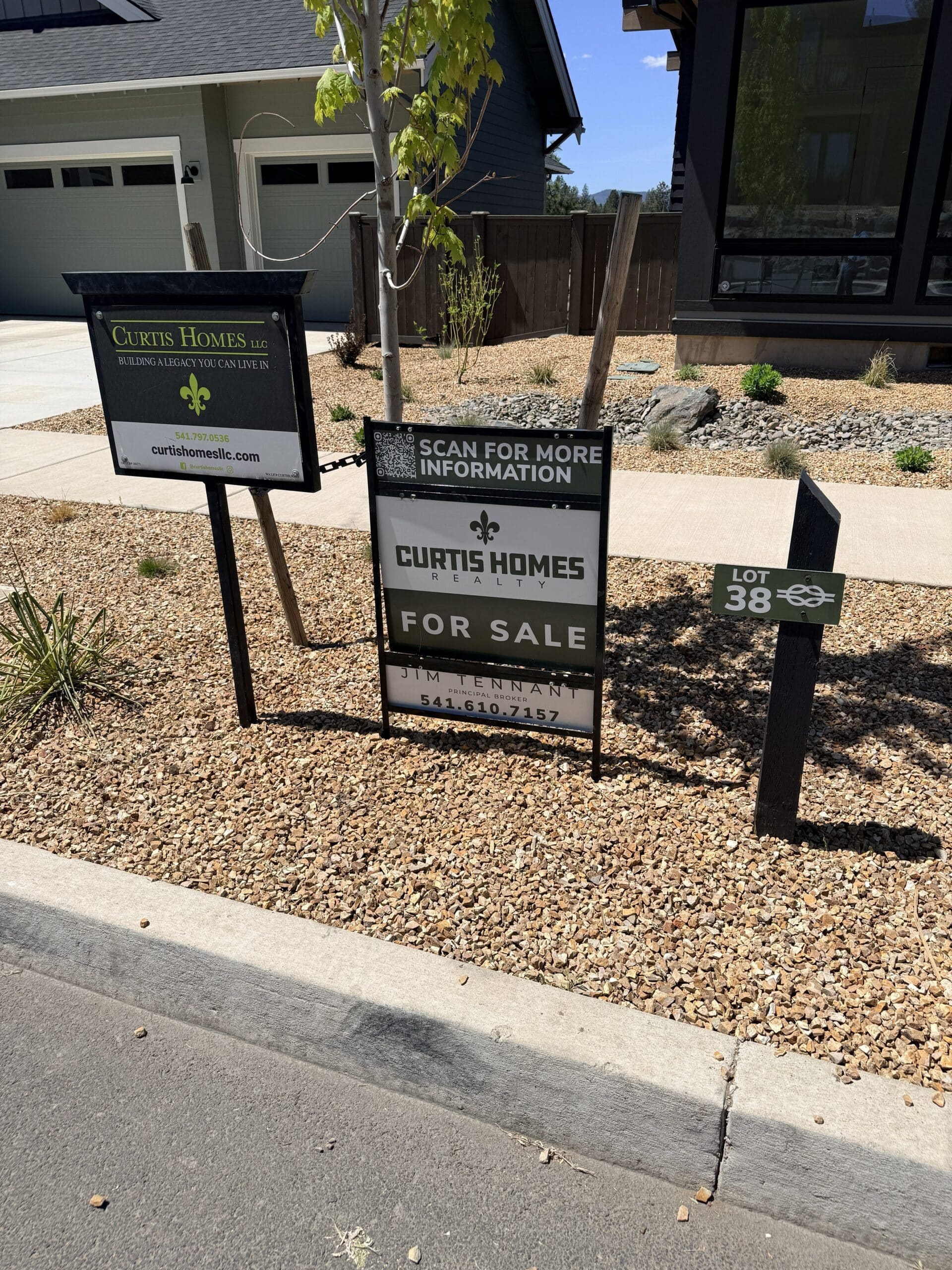
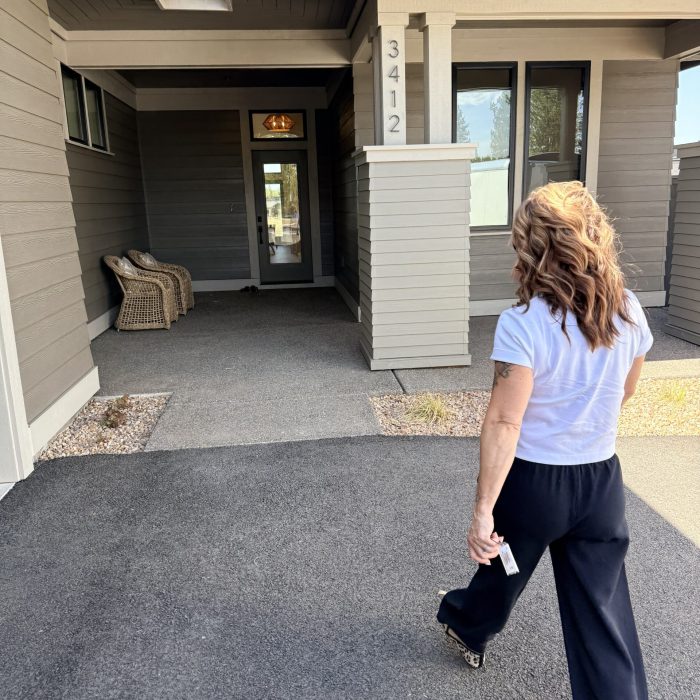
Nicole and I went through this exact process this year, buying a new build on Bend’s west side while also selling our home in Frederick.
If you are starting a housing search in Bend, prepare yourself.
Bend is one of Oregon’s most expensive housing markets outside the Portland suburbs.
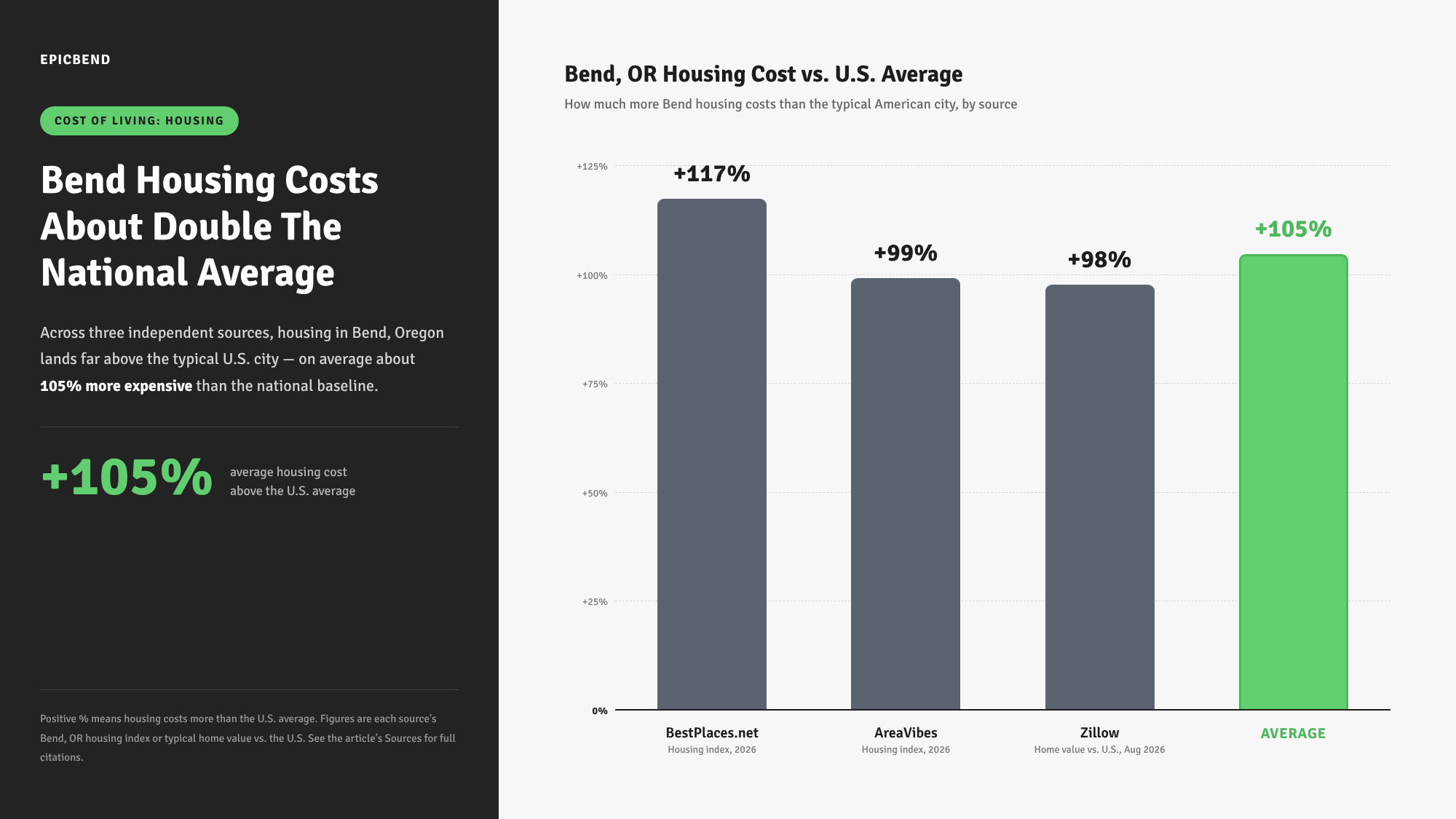
Zillow puts Bend’s typical home value at about $729,000 (August 2026). That’s roughly double the U.S. figure of about $369,000, and well above the Oregon ($496,000) and Deschutes County ($664,000) numbers.
The good news for buyers: prices have flattened, down slightly (about 1%) over the past year.

Prices also vary widely across Bend’s neighborhoods, each with its own character and price range.
West-side neighborhoods near Shevlin Park and Phil’s Trails, like NorthWest Crossing and Discovery West, sit at the top of the market.
Redfin recently showed NorthWest Crossing’s median sale price above $1.3 million, versus roughly $680,000 in Southwest Bend. The east side and southeast Bend generally offer more house for the money.

Nicole and I can tell you from experience that where you live in Bend will have the biggest impact on your finances. The biggest change in our finances after moving from Maryland to Bend was our monthly housing expense.
Of course, choosing a neighborhood in Bend involves many other factors, and we spent months researching, touring, and discussing with our real estate agent what mattered most to us in our move to Bend.

If you plan to rent when you move to Bend, expect to pay a bit above the national average (though the gap is much smaller than it is for buyers).
Across four independent sources, typical rent in Bend averages about $1,665 a month. Estimates range from about $1,295 (MIT’s living-wage housing budget for one adult) to $2,048 (Numbeo’s average one-bedroom). Apartments.com lands in the middle at $1,767, and BestPlaces puts a two-bedroom at $1,550.
Renting a house costs more. Listing sites that include single-family homes, like Trulia, show averages closer to $2,600, and three-bedroom houses often top $3,000.
Utilities Costs in Bend, OR
Utilities are one category where Bend lands close to the national average. Across three cost-of-living indexes, Bend utilities average about 4% above the U.S. figure, though the sources range from 16% below (BestPlaces) to 26% above (Salary.com).
Most homes get electricity from Pacific Power and natural gas from Cascade Natural Gas.
Bend sits at about 3,600 feet, though, so winter heating is a real line item, and you’ll need A/C in the summer.

Nicole and I would tell you we’ve hardly noticed much difference in our monthly utility costs between Maryland and Bend.
I wouldn’t make utility costs a major factor when considering a move to Bend.
Grocery and Food Costs in Bend, OR
Here is an area that Nicole and I discuss a lot because grocery shopping is a big deal for us, and we have slightly different preferences that affect our food costs.
First, the data: across three cost-of-living indexes, groceries in Bend average only about 2% above the national average. Estimates range from 2% below (Salary.com) to 5% above (AreaVibes), with BestPlaces in between.

But what you pay for food and groceries depends largely on where you shop.
For Whole Foods fans like me: Bend has one. You’ll also find other higher-end grocers like Trader Joe’s, Market of Choice, and Newport Avenue Market. I tend to prefer more premium, organic grocery stores. I’ve tried all of these, and they are great (though I will say Newport Avenue Market is too expensive even for me).
Bend also has plenty of ‘standard’ grocers like Fred Meyer, Safeway, and a large Costco. WinCo Foods and Grocery Outlet are popular discount options.

Overall, I’d say food costs seem slightly higher in Bend than what we experienced around Frederick, Maryland.
But it’s pretty easy to shape your grocery shopping habits around your budget in Bend, and it probably shouldn’t be a major factor in your decision to move to Bend.
One final note: my absolute favorite places to buy local produce, meats, and other products in Bend are at the NorthWest Crossing Farmers Market in summer, or at the Locavore specialty store…amazing and highly recommended!
Transportation Costs in Bend, OR
Bend is a car-dependent town. As mentioned above, many of us work from home. The rest commute to somewhere relatively close within town (not to a nearby metropolis).
Cascades East Transit runs buses, but routes are limited, so plan on driving for most errands (I’ve yet to take a bus in Bend).
The upside: most of Bend is a short drive (or bike ride) from everything else. Traffic here means roundabouts, not a congested interstate commute.
Gas costs more in Oregon. AAA’s Oregon average was about $5.00 a gallon in mid-October 2026, versus about $4.36 nationally. Bend often prices at or below the state average, thanks in part to competition from Costco.

Overall, cost-of-living indexes put Bend transportation about 6% above the national average, likely reflecting gas prices and residents’ reliance on driving.
Budget for winter, too. Snow and ice are normal from late fall through early spring, so plan on all-season or winter tires, and AWD helps if you’re heading up to Mt. Bachelor.

Air travel is the other transportation trade-off, and this has been a big change for Nicole and me.
Redmond’s Roberts Field (RDM), about 20 minutes from Bend, offers nonstop flights to about 10 western hubs, including Seattle, Denver, San Francisco, and Los Angeles.
That’s convenient for most trips. But flights back East or virtually anywhere internationally mean a connection, or a three-hour drive to Portland’s airport.

I will say after many years of hour-long drives to IAD, DCA and BWI from Frederick, plus the hassle of fighting a larger airport, I’ve somewhat enjoyed having a smaller airport as home base.
I’ve noticed it’s about 40 minutes from when I deplane at RDM until I pull into my driveway at home in Bend. This is a welcome trade-off for more trips with connections.
RDM is also expanding significantly (makes sense given the growth in this area), and I expect more direct destinations out of RDM in the near future.
Healthcare Costs in Bend, OR
For a town of about 100,000 people, Bend has a strong healthcare infrastructure. That’s because it’s the medical hub for all of Central Oregon.
St. Charles Health System runs four hospitals in the region (Bend, Redmond, Prineville, and Madras), plus clinics and urgent care. St. Charles Bend is the only Level II trauma center in Oregon east of the Cascades. Much bigger than I expected.

Cost indexes put Bend’s healthcare costs close to the national average. Estimates range from about 8% below (Salary.com) to 5% above (AreaVibes), averaging slightly below the U.S. overall.
The bigger issue for newcomers is access. Growth has stretched local providers, and some practices have waitlists for new patients. Start looking for a primary care doctor before you move.

For highly specialized care, Portland’s major medical centers, including OHSU, are about three hours away.
Entertainment Costs in Bend, OR
Here is where Bend shines and really delivers for the money. We moved to Bend because it offers so many things to do, and it’s probably a main reason you are considering it as well. Plus, so much of what we love about living here is free or inexpensive.
A big part of this website is dedicated to outdoor things to do in Bend, so I won’t repeat them all here.
But for example, Phil’s Trails and Shevlin Park are minutes from our house. We can bike ride out our front door to amazing terrain. Floating the Deschutes River costs little more than a tube, and dozens of spectacular hiking trailheads are a short drive away.

Read more about all the things to do in Bend in our Best of Bend, OR Guide.
Bend also has a surprisingly robust food, bar, and brewery scene for its size. The variety of Bend restaurants we find is far better than what we had in Frederick (which was also quite good).
This includes everything from food truck lots to high-end restaurants, and all types of cuisine.
Bend’s brewery scene is world-class. If you love craft beer, you may find it reason enough on its own to live here.

Where Bend entertainment does add up is gear and passes. We spend a decent amount on ski passes at Mt. Bachelor, mountain bikes, paddleboards, and other sporting goods and apparel.
I’m also a big golfer, so I spend a decent amount on green fees (and Bend has some amazing golf courses).
But these costs are easy to justify when you live in a place like Bend.
Our advice: budget for them. They are the reason most people move here.

Why Housing Costs Are the Real Drivers of Affordability in Bend, OR
If Bend looks expensive in your research, it’s most likely because of housing.
Housing indexes put Bend at roughly double the national average (about 105% higher across BestPlaces, AreaVibes, and Zillow home values), while groceries, utilities, and transportation sit within about 10% of it.
Overall cost-of-living estimates also vary widely by method, from about 4% above average (the federal BEA’s price index) to 34% (AreaVibes). The difference mostly comes from how heavily each one weights home prices.

The Bend, OR Housing Tradeoff
So expect some housing sticker shock. But for many considering a move to Bend, housing costs are more than just the numbers.
Bend isn’t the place you move to find a cheap mortgage or rent.
People move to Bend for the lifestyle, and they pay for it with higher housing costs.
RELATED READ
Retiring in Bend, Oregon: Why We Left Maryland
Our story of trading Frederick for the high desert: why we chose Bend, and how we found a neighborhood and a house from 2,500 miles away.
Read Our Story –>
Hidden Costs of Living in Bend, OR and Deschutes County
We’ve covered the major costs of living in Bend, but a few expenses can surprise new residents.
Oregon State Income Tax. Oregon’s income tax rates (4.75% to 9.9%) are among the highest in the country. Most middle-income households land in the 8.75% bracket, and the 9.9% rate starts at $125,000 of taxable income for single filers ($250,000 for joint filers).
Two offsets: Oregon has no sales tax, and it doesn’t tax Social Security benefits, which matters for retirees.

Property Taxes. Oregon’s property tax system is unusual. Taxes are based on an “assessed value” whose growth is capped at 3% per year, so bills usually run well below what a home’s market value would suggest.
Bend’s effective rate works out to roughly 0.6% of market value, with a median bill around $4,000 a year (U.S. Census data). That’s below the national average.
Watch for voter-approved levies, though. Bend homeowners saw bills rise about 8% in one recent year because of new bonds and levies.
Homeowners Insurance. Wildfire risk has pushed premiums up across Central Oregon. Oregon’s average premium rose about 46% from 2014 to 2024, and some Bend-area homeowners have seen premiums double or more, or policies dropped. Get insurance quotes before you make an offer.
Vehicle Registration. I had some serious Maryland car-registration shock as discussed in our Frederick cost of living article.
Oregon is the opposite. Bringing a car you already own means paying only title and registration fees. New cars bought from a dealer carry a modest 0.5% vehicle privilege tax. Yayy!
Where We Expect to Save Money Living in Bend, OR
Like in Frederick, we expect our biggest savings to come from recreation, transportation, and everyday spending.
No sales tax means every purchase, from groceries to new skis, rings up at the sticker price.
In Frederick, we spent more on gas as we took frequent long car trips to the D.C. and Baltimore areas. In Bend, everything is close.

Bend also has plenty to do without a big, expensive night out: concerts, festivals, and farmers’ markets fill the calendar, especially in summer. See our guide to things to do in Bend.

Plus, as mentioned, we’re big on the outdoors. Living in Bend means we can easily get to Mt. Bachelor, the Cascade Lakes, Smith Rock, and some of the best hikes in Oregon without planning a vacation.
Bend, OR vs Comparable Areas in Central Oregon and the West
Many of you are weighing Bend against nearby towns or other western mountain cities. Below is how typical home values compare.
| Area | Typical Home Value | What You Trade |
|---|---|---|
| Bend, OR | ~$729,000 | The full Bend lifestyle, at a premium |
| Redmond, OR | ~$511,000 | About 30% less, a short drive to Bend, next to the airport |
| Sisters, OR | ~$783,000 | Small-town charm, fewer services, higher prices |
| Deschutes County | ~$664,000 | Rural and small-town options around Bend |
| Boise, ID | ~$508,000 | Bigger city, lower prices, less mountain access in town |
| Oregon (statewide) | ~$496,000 | State baseline |
| United States | ~$369,000 | National baseline |
Source: Zillow Home Value Index, August 2026 (Boise: May 2026).
The story of this comparison is that there is no single ‘best’ Central Oregon town to live in; it comes down to your priorities. (However, we really love Bend!)
Bend is not the cheapest. Redmond offers real savings if you don’t mind the drive. And compared with Portland, Bend’s homes cost more, but Portland-area residents pay extra local income taxes on top of Oregon’s.
Bend’s appeal lies in the combination of lifestyle, outdoor access, and a small-city feel, not in low prices.
Bottom Line: Is Living in Bend, OR Worth the Costs?
Deciding whether Bend is right for you involves many factors. For Nicole and me, moving here is the culmination of a 20-year dream, but our situation is unique to us (semi-retired, no commute, no school districts to weigh).
Hopefully this article has helped you understand what it really costs to live here.

For readers who value the outdoors and a small-city lifestyle, we think Bend’s cost of living is worth it.
Bend isn’t cheap, and housing will be your biggest hurdle. Its appeal is the combination of mountains, trails, rivers, and community you get for your money.
Sponsored · Our Bend Real Estate Partner
photo
Your Name Here
Brokerage Name · Bend, OR
Thinking about moving to Bend? This spot is reserved for the one local agent or team we trust to help readers find the right neighborhood, from the west side near Shevlin Park to the east side and Redmond.
Talk to a Local AgentAre you a Bend agent? This exclusive spot is open. Ask about becoming our founding partner.
Frequently Asked Questions - The Cost of Living in Bend, OR
Is Bend, Oregon Expensive to Live In?
Yes. Sources put Bend’s overall cost of living anywhere from about 4% to 34% above the national average, roughly 19% on average. Most of that comes from housing, where typical home values are about double the U.S. average.
Outside of housing, costs like utilities, groceries, and transportation are close to average, and Oregon has no sales tax.
How Much Do You Need to Earn to Live Comfortably in Bend, OR?
It depends on whether you rent or buy. Typical rent averages about $1,665 a month across sources. Keeping that at 30% of income takes roughly $67,000 a year in household income, or about $60,000 to $80,000 for most apartments.
Renting a house or buying is a bigger stretch. One early-2026 analysis estimated it takes about $185,000 a year to afford Bend’s median listing price.
Is Bend Cheaper Than Portland?
It depends on the category. Bend’s home prices are higher than Portland’s.
But Portland-area residents pay additional local income taxes on top of Oregon’s, and several comparisons show everyday costs like transportation running higher in Portland.
Are Taxes High in Bend, Oregon?
Income taxes are high. Oregon’s rates run from 4.75% to 9.9%, among the highest in the country.
Other taxes are low. Oregon has no sales tax, doesn’t tax Social Security, and Bend’s property taxes average roughly 0.6% of market value, below the national average.
Are Home Prices Expensive in Bend, OR?
Yes. Zillow puts Bend’s typical home value at about $729,000, roughly double the national figure and among the highest in Central Oregon.
Prices vary widely by neighborhood. The east side, condos and townhomes, and nearby towns like Redmond and La Pine cost considerably less.