


Thinking about living in Frederick and working in Washington, DC? Nicole and I moved to Frederick ourselves, and while neither of us commutes to Washington, D.C., many of our friends and neighbors do. It’s a frequent topic of conversation, and we also drive to DC frequently for other reasons.
For many people considering a move to Frederick, the commute is the deciding factor.

Frederick can be an appealing place to come home to. But if your job is in Washington, commuting from Frederick, MD, to DC deserves as much attention as the Frederick house you’re considering.
The honest answer? This commute can work, especially with a hybrid schedule. It becomes a much bigger commitment when you need to be at a downtown DC desk five mornings a week.
Your office location, working hours, and neighborhood matter enormously. So does your willingness to trade time on the road for the lifestyle you want at home.
Before you move here, let’s walk through the options and questions that will help you decide.
Commuting from Frederick, MD to Washington, DC
Quick Summary: Commuting from Frederick MD to DC
There is no single best way to make this trip. Start with where you work, then choose the route that fits your day.
| Commute Option | Best For | Main Tradeoff |
|---|---|---|
| Drive to your office | Changing hours, convenient office parking, or destinations awkward to reach by transit | Traffic and driving and parking costs |
| MARC Train from Frederick or Monocacy | Weekday commuters whose hours match the trains | Limited departures and travel from the arrival station to work |
| Drive to Shady Grove, then Metro | Offices near the Red Line and people needing return-trip flexibility | Driving the I-270 portion plus parking and rail costs |
| Route 515 bus, then Metro | Riders who can use the stops and scheduled departures | Road traffic plus the Metro connection |
Our recommendation: Test your actual trip before choosing a home. Take it on a normal workday, at the time you would really leave, and repeat the trip home.
Why Consider Living in Frederick and Working in DC?
A relocation decision involves much more than getting to work. What do you want your evenings and weekends to look like? Would you rather have a walkable neighborhood, more space at home, or easier access to the activities you enjoy?
Frederick may fit those priorities. But a home that looks ideal on Saturday afternoon can feel very different after a long Tuesday commute.
Use our pros and cons of living in Frederick MD as a starting point for that broader decision. Then put the commute alongside the other things that matter to your household.
The aim is to find a place you’ll enjoy living without giving away more of your week than you intended.
1. Driving from Frederick to Washington, DC

Why Choose It: Driving lets you set your departure time and go straight to your destination. It can be practical if you work unusual hours, carry equipment, or have an office that requires several transit connections.
For many trips into Washington, you’ll travel south on I-270, then follow the route that best serves your office. The final portion matters: an office in northwest Washington is a different trip from one across town.
Even though I don’t commute to DC, I travel on I-270 south from Frederick very frequently. Let me tell you- its trafficky! You can usually count on heavy traffic from Frederick south past Urbana, about 10 miles south, where the highway changes from two lanes to four.
Don’t plan your move around the fastest time you’ve ever seen on a map. Look up your exact home-to-office route with a weekday arrival time, check several days, and compare the return journey too.
Parking also belongs in the calculation. An employer-provided space changes the economics considerably. A paid garage followed by a walk to the office adds both money and time.
Best For:
- Flexible or nontraditional working hours
- Convenient parking at work
- Offices poorly served by transit
- People who need a car during the workday
What to Check Before Choosing Driving
Ask yourself how much variation you can tolerate. If a delay means missing a school pickup or arriving late for a shift, flexibility matters more than a good average travel time.
Build a backup plan before you need it. Know what you’ll do when traffic is unusually bad, your car needs service, or you need to get home unexpectedly.
2. Frederick MD to Washington DC by MARC Train

Why Choose It: The train lets you skip driving the full route. If your office is close to its stops and your hours match the timetable, MARC is worth serious consideration.
The Brunswick Line timetable, effective September 28, 2026, lists these direct weekday morning trains:
| Train | Frederick Departure | Monocacy Departure | Union Station Arrival | Frederick to Union Station |
|---|---|---|---|---|
| 890 | 5:00 a.m. | 5:06 a.m. | 6:40 a.m. | 1 hr 40 min |
| 892 | 6:22 a.m. | 6:30 a.m. | 8:15 a.m. | 1 hr 53 min |
| 894 | 7:10 a.m. | 7:17 a.m. | 8:52 a.m. | 1 hr 42 min |
Direct return trains leave Union Station at 3:45, 4:55, and 6:40 p.m. and arrive in Frederick at 5:29, 6:38, and 8:21 p.m., respectively. These are scheduled times, not guarantees. Check the current timetable and service alerts before traveling.
Best For:
- Predictable weekday working hours
- Offices near Union Station or another convenient stop
- Commuters comfortable planning around specific departures
- People who would rather read or relax than drive the entire trip
Include the Whole Trip
Your commute begins when you leave home. Getting to the station, parking, reaching the platform, and arriving early all take time. So does getting from the train to your desk.
For an office near Union Station, that last leg may be straightforward. For an office elsewhere in Washington, compare a Metro connection with other options instead of assuming Union Station is the best place to transfer.
And study the return trip carefully. A late meeting can affect your evening much more when departures are limited.
3. Driving to Shady Grove and Taking Metro

Why Choose It: Washington, D.C., has a fabulous Metro rail system. This option combines driving with a Metro rail trip into Washington. It suits people whose offices are close to the Red Line and who want flexibility beyond MARC departure times.
Shady Grove is a Red Line station with commuter parking. Start with WMATA’s Shady Grove station information and its trip-planning tools to check your destination.
The station currently lists weekday daily parking at $5.20. Standard weekday Metro rail fares between 5 a.m. and 9:30 p.m. range from $2.25 to $6.75 each way, depending on the trip. Use WMATA’s fare information to calculate your specific journey.
You’ll still encounter road conditions on the drive to the station. Add time for parking, walking, waiting, and the final walk to work.
Best For:
- Offices near the Red Line
- People needing different departure times on different days
- Commuters who want to avoid driving into central Washington
- Households comfortable keeping a car for the trip to the station
Compare It with MARC Before Deciding
Metro may offer a better fit for your office even if MARC looks simpler on paper. Compare complete trips rather than one train ride against another.
Try both if you can. Pay attention to how the trip feels and how long it takes. A route involving more steps may still be easier for you to manage.
4. Taking the Commuter Bus and Connecting to Metro
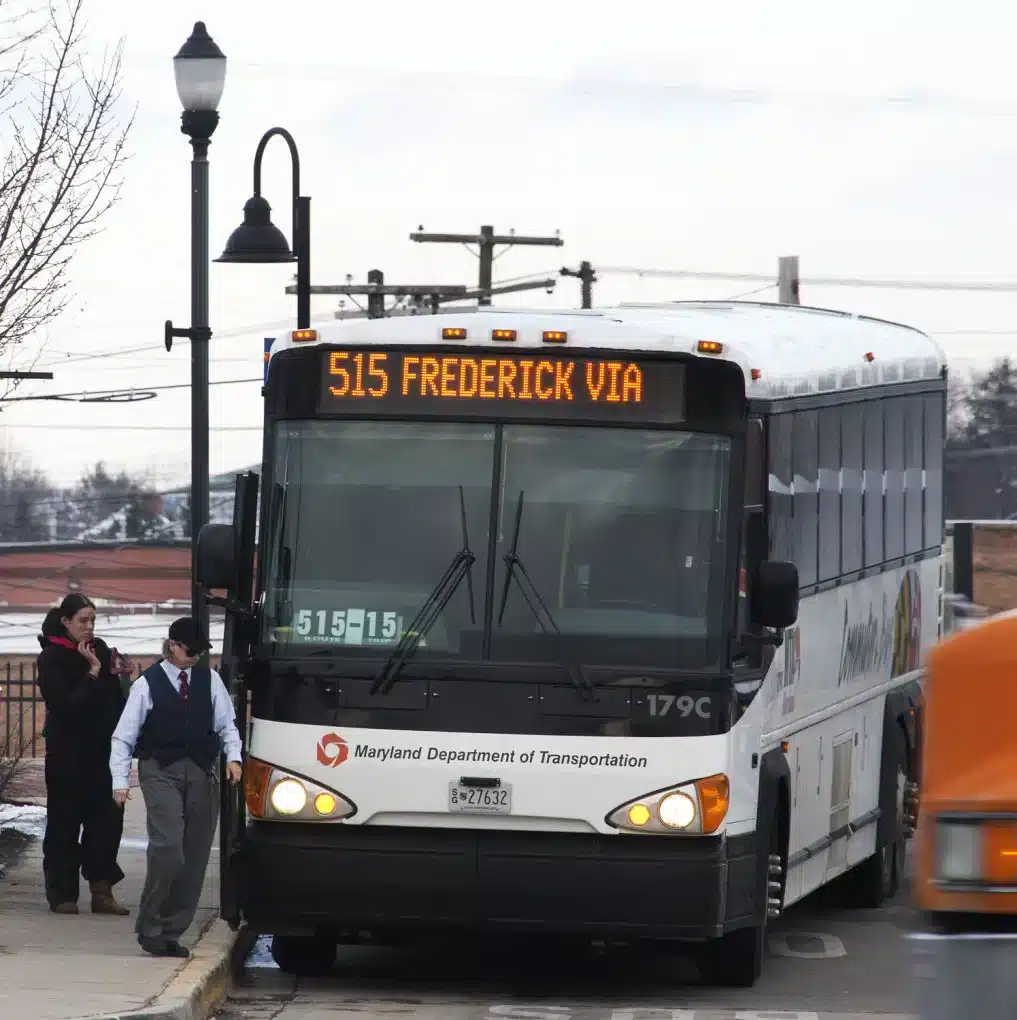
Why Choose It: A bus connection lets you leave your car closer to home, as long as the stops and schedule work for you.
Maryland MTA’s Route 515 serves the Frederick–Shady Grove/Rock Spring corridor. Check the selected trip’s stop list, operating date, and return schedule rather than assuming every departure serves every stop.
For a DC office, compare the bus journey to Shady Grove and your onward Metro trip. Include the wait between services in both directions.
Best For:
- People who can easily reach a served stop
- Work schedules that match available bus trips
- Commuters who prefer less driving
- Riders willing to make a bus-to-rail connection
Remember That a Bus Still Uses the Road
Taking the bus changes who drives. It doesn’t remove the road portion of the journey.
If your workday has a firm start time, leave room for the connection. Also check how you would get home if you missed your usual departure.
5. The Frederick to Rockville Commute

Why Choose It: Working in Rockville (or nearby towns) changes the decision. Many large company HQs are around Rockville.
You may be able to finish your trip before reaching Washington, but the exact office address still determines the best option.
The current MARC timetable includes Rockville stops on the direct morning trains to Frederick. Compare those with driving and, where practical, a bus connection. An office near the station is different from an office park that requires another ride.
For driving, enter the actual building in your navigation app. “Rockville” covers more than one possible destination, and the last few miles can matter.
Best For:
- People comparing Frederick with homes closer to Montgomery County jobs
- Offices convenient to a rail station
- Workers whose schedules allow them to adjust departure times
Treat the Frederick-to-Rockville commute as its own test. Don’t use someone else’s downtown DC experience to decide whether it will work for you.
Choosing a Frederick Neighborhood with the Commute in Mind

Before falling in love with a house, decide whether you’re primarily a driver, train rider, or Metro commuter.
Then test the first part of that route. For a driver, it’s the trip from the driveway to the highway. For a train rider, it’s reaching the station with enough time to board comfortably.
Start with our best neighborhoods in Frederick MD guide to explore the area. Shortlist homes based on your desired lifestyle, then compare each address against your chosen commute.
Consider southern locations such as Ballenger Creek or Urbana if highway access is a priority. If you prefer downtown living (and being close to Frederick restaurants and bars), measure the trip to the station or highway from the particular property. These are areas to investigate, not promises of a faster commute.
A small difference each way can become a meaningful weekly commitment. If one home adds 15 minutes in each direction and you commute five days a week, that’s another 2½ hours away from home.
RELATED READ
The Best Neighborhoods in Frederick, MD
Explore the Frederick neighborhoods we recommend, from walkable downtown streets to commuter-friendly suburbs near I-270.
Read The Full Guide –>
What Will the Commute Cost?
Compare complete monthly costs, including the days you actually travel.
| Option | Costs to Include |
|---|---|
| Driving to DC | Fuel, maintenance, vehicle wear, office parking, and any tolls on your chosen route |
| MARC | Tickets or passes, station access, and onward transportation |
| Driving plus Metro | Driving costs, station parking, and Metro fares |
| Bus plus Metro | Bus fares, Metro fares, and travel to the bus stop |
Ask your employer about commuter benefits before buying a pass. With a hybrid schedule, calculate whether individual fares or a pass better matches your travel pattern.
Then add those costs to your broader household budget. Our cost of living in Frederick MD guide can help you think through the rest of the move.
Before You Make the Move, Try Your Future Workday
Pick a weekday and leave from the neighborhood you’re considering at your real departure time. Travel all the way to the office, including parking or connections.
Repeat the journey home. Notice when you would have dinner, whether you could handle your usual errands, and how much evening you would have left.
Frederick might be exactly where you want to live. A realistic trial commute helps you choose a home you can enjoy throughout the week.
Frequently Asked Questions About the Frederick MD to DC Commute
Is Frederick MD Too Far from DC?
It depends on your schedule and how much you can handle traveling.
A couple of office days each week may be manageable for you. Five days can be a much larger lifestyle trade-off. Test the journey before committing to a move.
But plenty of Frederick residents work in DC and commute there everyday.
What Is the Frederick MD to DC Commute Time?
There is no reliable single door-to-door number. Driving commutes likely average 45 to 60 minutes in DC, and less to Montgomery County suburbs.
The direct morning MARC journeys listed above take roughly 1 hour 40 minutes to 1 hour 53 minutes from Frederick to Union Station downtown.
You still need to add station access and the trip to your office. Driving and bus-plus-Metro times require checking your exact route and departure time.
Does Metro Run Directly to Frederick?
No. The Metro option described here starts by reaching Shady Grove. This station is about a 30- to 40-minute drive from Frederick.
MARC is a separate rail service, and the bus connection has its own schedule and fare.
Can You Use MARC for a Weekend Commute?
The Brunswick Line runs on a regular timetable Monday through Friday.
Don’t build a weekend work plan around these trains; check other transportation options for your specific shift.
Is Living in Frederick and Working in DC Worth It?
Absolutely! If the home and lifestyle fit your priorities and the commute fits your week.
Before deciding, count the travel hours, price the transportation, and consider how much flexibility you’ll need when work or family plans change.
More Help Planning Your Move to Frederick